One Step in the Evolution of a Design Studio Assignment
by Jiun-De Chen & Ann Heylighen
Introduction
Since design pedagogy is project-oriented, studio assignments play a key role in architectural design education. Especially at the entry-level, studio teachers develop assignments as vehicles to transfer design knowledge to students, as well as to guide them through various experiences for constructing design expertise of their own. These assignments may be either invented, or adopted and reformulated from previous terms or other schools. In the latter case it is assumed that the essence of existing assignments is still applicable to present didactic purposes, yet certain adjustments are needed in response to the new situation. Some assignments could be adopted and adapted several times for various reasons. This chapter aims to investigate in the case of one particular assignment how and why this kind of adaptation evolves, and what its implications may be in the light of current trends in architectural design education.
The case presented is an assignment arranged by the first author when he was teaching the first-year design studio as a part-time tutor in the Department of Architecture, Feng Chia University in Taiwan. The primary intention of this studio exercise was to guide students in creating and articulating a spatial sequence, assisted with compositional principles they extracted from assigned case references. The assignment was revised in an attempt to fit into the curriculum plan of that school term, as well as to enhance its pedagogical effectiveness.
There are multiple issues that can be illustrated with the revision of this studio assignment and its consequences. Firstly, case reference and analysis is a widespread approach in design activity, and can be carried out explicitly in studio assignments. In this assignment it was integrated into the operational process as part of the project requirements. Secondly, re-using assignments and modifying them for new situations represent another layer of case reference and analysis. Finally, the evolution of design assignments depicts one aspect of shaping design teaching of architecture.
Case reference as strategy
Cases—also called precedents or examples—play an important role in architectural design thinking (Dave et al. 1994, Heylighen 2000, Akin 2002, Heylighen & Neuckermans 2002). A case encapsulates knowledge about a previous design solution that may be useful for future design situations. This knowledge is expressed in the form of an architectural object, including all the details that make the design unique. By consequence, cases potentially contain knowledge about every single aspect of architecture, as well as about the integration of different aspects into a coherent whole. Moreover, some cases— especially those that are influential as masterpieces—contain not only formal grammars for students to learn from, but also value systems of spatial concepts for passing on to later generations.
The merit of cases as vehicle to communicate design knowledge and values was already acknowledged in the early 19th century by Jean Nicolas Louis Durand. He is usually cited in relation to typology, because of his work on generative mechanisms for designing buildings classified by their function. Yet, rather than a catalogue of building types, the original version of Durand’s Recueil may very well be considered as a case base avant la lettre. The Recueil is a collection of 92 ‘planches comparatives’, which compare particular buildings with the same functional program by their plans, elevations and cross sections (Durand 1801). Originally, the work had two pedagogic functions: it served as an encyclopaedia, in which architecture students could find examples for the courses on drawing and analysis; in addition, ‘les beaux plans’ and ‘les grandes compositions’ were used by the students as source of inspiration for their own design projects. Throughout the successive editions, the level of abstraction increases (Huet 1984) yet the original version seems to have been inspired by an intention to use concrete cases to inform design education in architecture.
Presently, however, design teachers seem less confident about the role of cases in design pedagogy (Heylighen & Neuckermans 2002). Teachers admit that students can learn a lot from consulting existing projects during design, yet when it comes to stimulating or supporting this strategy, opinions are more divided. For some, reference to cases by students may perhaps be pardonable, it is absolutely not to be applauded, let alone encouraged; others are convinced that students would benefit from such encouragement. The latter view is consistent with the results of an experimental study, which suggests that exposure to cases during design has a positive effect on the quality and originality of students’ design projects (Heylighen & Verstijnen 2000).
When educating entry-level students, architectural cases have different roles to play. Design teachers usually select projects that tend to be more abstract and unrealistic for novices to focus on primary subjects, especially when the didactic aim focuses on the making of form and space per se. Without functional requirements and practical situations embedded to simulate realistic building projects, students need other strategies to search for a starting point and potential solutions to the design task at hand. Usually they are encouraged to explore every possibility, but lack the necessary skills and tools to do so. Thus assignments are “designed” as a pathway for students to build up these capacities. And referring to architectural cases at this level serves as a strategy to enhance analytical skills in spatial design, as well as to improve conceptual development about architectural spaces.
Without textbooks as guidelines to be followed in lecture courses, the didactics of the architectural design studio mainly builds on serial assignments as a framework to structure all the components in a design curriculum. Especially for the entry-level, the assignments must integrate theoretical issues, performance skills, and working disciplines into operational processes through which the students are “learning by doing” (Schön 1985) and able to acquire a certain know-how, as well as to construct their personal knowledge (Polanyi 1964) with tutors’ guidance. On the other hand, it is quite common that tutors direct students to certain precedents for specific traits, which may help to unravel some problems encountered in the design process. Usually this is an informal but constantly used strategy in a one-to-one desk-crit, or in a jury review for making comparisons. For the assignment discussed here, however, precedent reference becomes a formulated process within explicit requirements. Learners study the precedents and demonstrate what they found, then apply the lessons learned to their own projects.
Developing a design concept by referring to cases, however, takes a different approach here. Instead of letting students find cases arbitrarily, specific precedents were assigned to them for studying. The intentions were multiple. Firstly, these cases possess strong characteristics of formal composition that closely relate to the exercise, and serve as proper stepping stones for novices to sense the effectiveness of design principles in constructing both abstract form/space and concrete architectural entities. Secondly, by focusing on a selected group of cases students may consult many ways of analysing the same buildings from other persons (colleagues, instructors, or book authors) and broaden their perspectives on the subject. Furthermore, these masterpieces have been so influential in the design concepts of contemporary architecture that it is better for students to consult them in an analytical way than to obtain superficial impressions only.
Outline of the case and its context
When educating entry-level architectural students, tutors tend to arrange exercises that are abstract and imaginative for them to concentrate on the primary elements and processes of designing. Especially some schools define this level as basic design training rather than professional education. This concept of basic design can be traced back to the Basic Course at the Bauhaus (Itten 1963, 1975) which focused on the elementary study of form. Since then this approach is widespread in contemporary architectural education. Although the approach and implementation nowadays may be quite different from the original one in the Bauhaus, studying the principles of form making is still the key issue. The case discussed here belongs to this genre of curriculum framework in the university system.
The main role this case had to play in that academic year was to assist students in progressing from shaping basic, singular space to arranging more complex spatial sequences. Before this assignment they had designed a personal corner to nestle, and the following project was about creating several interior spaces with various functions like working, meeting, and displaying. In order to bridge these two exercises, the studio coordinator and tutors came to agree that this assignment should focus more on the skills of articulating multiple spaces, yet at the same time integrating them as a unity with compositional principles. It also had to acquaint students with geometric concepts as basic reference for composition. The teachers assumed that geometric concepts are an important tool for designers to generate and organize architectural spaces, and therefore would assist students in constructing a reliable framework to make architectural forms.
The teachers’ strategy was to re-use a previous assignment that appeared to be effective for this didactic purpose.
Actually the assignment had been re-used many times. Its original core is quite simple: try to cut, fold, or bend a piece of rectangular cardboard (8cm by 100cm) to construct a model of spatial sequence, yet without any segment being detached from the main piece (See [image01.jpg] as an example of a quick test by the first author to check the possibility of this exercise); then locate it on a base (75cm by 75cm), which also can form part of the spatial composition [image02.jpg]. There is no functional consideration, only an abstractive formation of serial spaces. It is like a play in shaping spaces with planar elements that are interconnected. Thus all of these spaces would definitely be joined, as was the didactic aim of the assignment.

Fig. 1. A quick test of the assignment to check whether it is really doable.
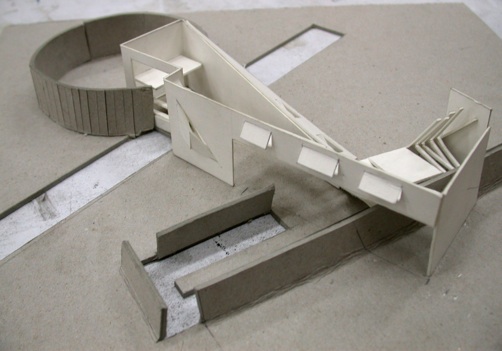
Fig. 2. The square base could also be cut and folded to form some parts of elements to shape spaces with the cardboard.
This play, however, did not guarantee that the spaces created would be articulated and integrated in a sense of unity. The designer had to apply an order, a theme, or some principles to organize it. But previous experience in carrying out this exercise showed that most of the novices were lacking the capacity to cope with the task. Although students may be guided through diverse pathways individually or in small groups, the teachers who had used the exercise in the past urged that the studio setting provide a more collective mode of learning, at least at this level, for developing this kind of capacity. Some suggested showing students good examples (from the tutors’ point of view) of this exercise done before in order to give them an idea of what could be achieved; others proposed to require students to study some architecture precedents that possess strong characteristics in terms of spatial organization. The latter also believed that the study could inspire students as to how their abstract compositions can be related to architectural design, and help them to tackle the problem at hand. Consequently case reference and analysis was incorporated into this assignment.
From then on, a set of cases was chosen for students to study: Le Corbusier’s Villa Savoye, Frank L. Wright’s Robie House, and Mies van der Rohe’s Barcelona Pavilion. The assumption was that by studying these examples students could acquire fundamental concepts of spatial formation. For example, the Villa Savoye demonstrates Le Corbusier’s “Five points” of the New Architecture, which are still influential to contemporary architects; the Barcelona Pavilion is an excellent illustration of the fluid space concept defined by orthogonal panels and liberated architects from the convention of enclosed room. The purpose is not for students to embrace these principles as the one and only correct answer, but to let them experience the potential of compositional principles in formulating architectural space, and in turn to make use of them to develop their own projects.
Several methods and examples for analyzing architectural configuration were introduced to the students as well. By way of illustration, the seminal books Architecture—Form, Space, and Order (Ching 1996) and Precedents in Architecture (Clark & Pause 1996) were appointed as references, which provide elementary principles of perceiving built environment and architectural precedents. In addition to emphasizing an analytical attitude, the assignment also demanded that the study be presented with diagrams and sketch models [image03.jpg, image04.jpg]. In this way students would build up their own understanding about case analysis through hands-on experience.


Fig. 3-4. Students’ presentation boards with the analysis of the first set of cases, showing two different interpretations to the Barcelona Pavilion.
Unfortunately, as most of the design tutors experienced, there was a wide gap between what students presented in their case analysis and the design approaches they adopted for the assignment. They seemed to treat these two types of operation as unrelated assignments instead of two facets of one design process. Or—even worse—they did not know how to apply the knowledge acquired from the case analysis to designing. A better strategy had to be proposed.
New adjustments
When the first author took over the assignment and tried to fit it into the curriculum structure of that year, he intended to amend its deficiency mentioned above, and at the same time to incorporate the context of the studio conditions. One condition was that the timeframe to run the assignment in that semester was longer than before, so there was more time for practice. Another one pertained to the following assignment that asked for arranging spaces within an existing structure. The need to make a stronger link between these two assignments motivated the modification as well.
One of the main changes was to repeat the analysis-then-creation procedure. In other words, after one week of analyzing the cases and transforming the cardboard to create spatial models as a quick sketch design, students had to repeat the sequence. Protocol studies of design processes revealed the iteration between analysis and synthesis to be one of the characteristics in design thinking (Dorst 1997). Here the studio assignment intended to highlight this trait and make students familiar with this way of practicing.
Another change was that the cases to be studied in the second run were different from those in the first: Richard Meier’s Grotta House, Peter Eisenman’s Guardiola House, Frank O. Gehry’s Vitra Design Museum, Steven Holl’s Chapel of St. Ignatius, Rem Koolhaas’ Villa Dall’Ava, Alvaro Siza’s Banco Borges & Irmao, Tadao Ando’s Kidosaki House, Ben Van Berkel’s Möbius House, and Morphosis’ Crawford Residence. It was assumed that the formal concepts of these architectural precedents diverge greatly from those in the first set, but are related in some respects. For instance, Richard Meier is well known for adopting ideas from Le Corbusier, Mies van der Rohe, as well as Frank L. Wright (Ockman 1984); and the Grotta house is a good example of this adoption. The Möbius House displays a continuously fluid space, like the Barcelona Pavilion, while the topological notion of a Möbius strip is totally different from Mies’ orthogonal planar geometry. Yet the intention was not to analyze the relations between these two sets of cases, but to inspire students by showing how the principles found in the first run could further evolve.
The third change was concerned with bridging the gap to the next assignment. In the proposed site for the interior design project there were several structural columns that could not be removed, as a primal constraint to the exercise. (See [image43.jpg] for one example of a student’s design.) A column, in the abstract formal concept of three-dimensional composition, is a vertical linear element, which differs from a wall or roof as planar element operated in this cardboard modeling exercise. To make students familiar with these two types of elements in forming spaces, one more requirement was added: students were asked to impose a series of vertical sticks into the spatial sequence model. These sticks could act as free-standing elements, or support some parts of the cardboard segments, to reinforce the motif of the spatial sequence.
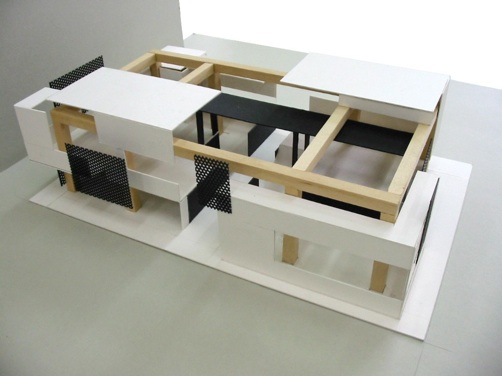
Fig. 5. The project following this assignment imposes existing columns and beams as constraints to the design exercise.
Consequently, the assignment was structured into several steps:
Step 1) Case study: each group (11~12 students guided by one tutor) distributed the three cases (3~4 students studied the same case individually) and analyzed the formal articulations and geometrical characteristics that contribute to the compositional principles in spatial organization inherent in these cases. They had to present their findings to each other, not only with diagrams but also with concept models. In this way the principles they found in architectural objects could be perceived and discussed with two- and three-dimensional media. [image03.jpg, image04.jpg]
Step 2) Forming spaces: based on the findings in step 1, students had to propose five sketch models of the cardboard construction [image05.jpg~ image08.jpg]. The teachers used to ask for three before, but found out that three resulted in too little diversity for assessment and more than five would require too much effort from the students. These two steps were rapidly executed within one week as a warm-up, and to make students experience the analysis-then-creating process as well as the potential of the cardboard construction.
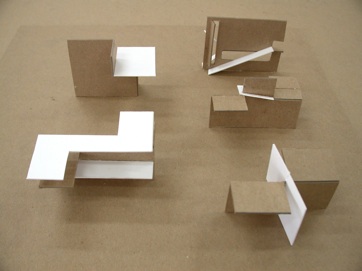
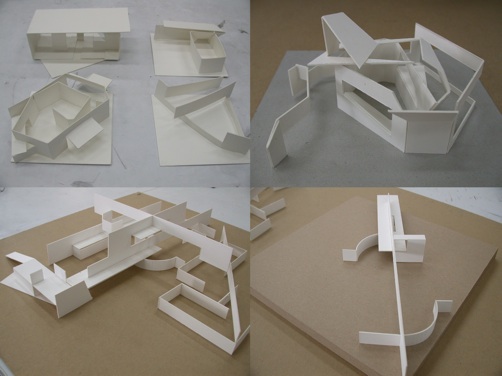
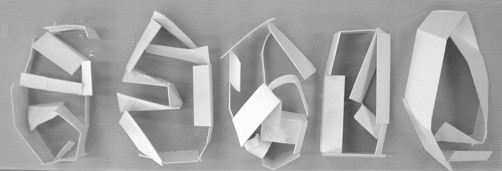
Fig. 6-9. Sketch models as the first test of spatial composition created by the cardboard construction.
Step 3) Repeat step 1 and 2: with another group of cases, students practiced the analytical skills again. This time they could pay attention to the derivative shapes that distinguish these cases from the first group of precedents, especially the possible concepts of spatial organization that structure these projects [image09.jpg~ image12.jpg]. Then, as in the first run, each student had to submit five proposals, and select one of them for further development through discussions with the tutors [image13.jpg~ image16.jpg]. This step was also implemented within one week to intensify students’ hands-on experience again.
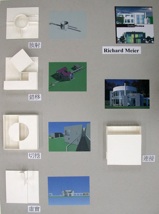
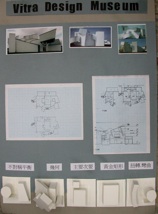
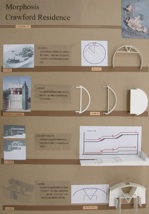
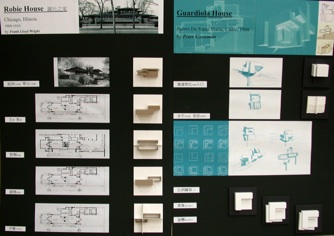
Fig. 10-14. Case studies of the second group of precedents, mid-term presentation boards for step 3.
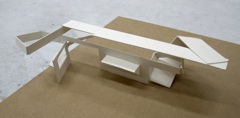
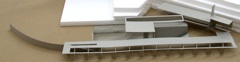
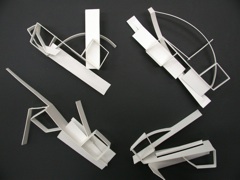
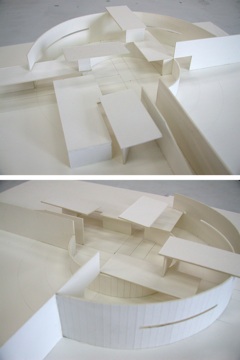
Fig. 15-19. More developed proposals after the second run of analysis-then-creating process.
Step 4) Elaborate the spatial sequence: At this stage the efforts were devoted to developing and fine-tuning the cardboard model. But through the individual desk-crit or group discussion, the findings acquired from the case analyses were frequently brought into discussion for the project development. Students were even encouraged to refer back to previous steps for gaining more information from their case analysis, and internalize it as personal design skills. They had one and a half weeks to go through this step and met for a mid-term review of the exercise [image17.jpg~ image20.jpg].

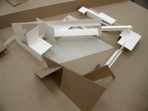
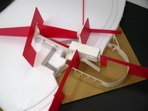
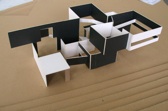
Fig. 20-23. Students’ presentation boards and models for the mid-term review.
Step 5) Add vertical sticks as columns: 12 sticks had to be placed into the spatial sequence within a continuous grid system set by the designer. The system module had to be allocated between 6 and 8 centimeters (imitating the general distance of columns in an architectural structure at scale 1:100). Their heights might be adjusted according to the planar segments around them. These sticks could form a colonnade or enclose a square, or even be allocated to different areas in the cardboard model, depending on what kind of relations they would build with the spatial sequence. Accordingly the cardboard assemblage could be modified to interplay with the imposed column system in order to highlight the compositional principles the model presented. [image21.jpg~ image24.jpg]
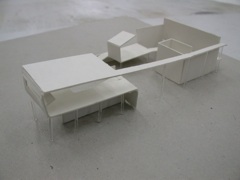
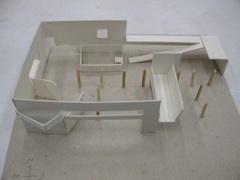
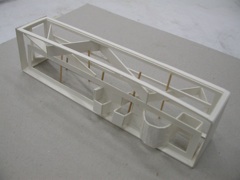
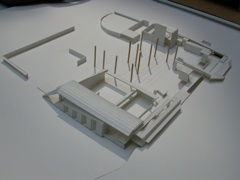
Fig. 24-27. Examples of adding vertical sticks as columns into the compositional models.
Step 6) Applying materials: Students could replace some elements of their models by different materials. This step was inherited from the original assignment to experiment with how the properties of and the relationships between the established spaces would be affected by the visual materialities (transparent, translucent, opaque, reflective...) that define them. This step was put at the end to keep the main exercise (cardboard manipulation) purely focused on shaping space with one neutral material, which allowed students to concentrate on the form itself at first. By the same token, students could reconsider certain properties of their designs with newly applied materials and make adjustments if needed. This step actually functioned as an auxiliary improvement to the design. [image25.jpg~ image30.jpg]
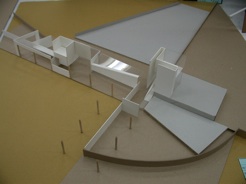
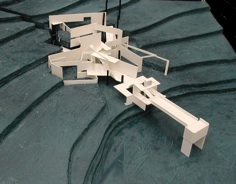
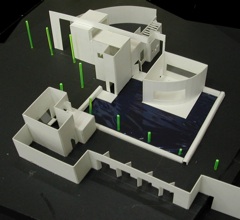
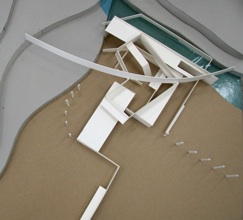
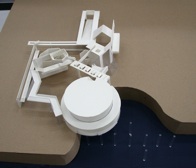
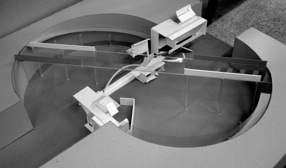
Fig. 28-33. Applying different materialities to some parts of the compositional model for examining their influence on the whole complex.
Some extra tricks have been passed down through generations of teaching. For instance, the cardboard’s rectangular shape suggests an orthogonal coordinate system as reference, which can lead to a more manageable approach to the task. Its dimensions represent an 8 meters high and 100 meters long wall at scale 1:100, hinting at manipulating the slab to create floors at different levels according to human scale (see [image27.jpg], [image34.jpg] as examples). Another example is the fact that the square base does not have to be flat. The cardboard could be associated with a slope (see [image26.jpg], [image28.jpg]) or a terrain in various shapes and heights (see [image25.jpg], [image32.jpg]). Some students imagined the base as a virtual environment with a river or waterfront (see [image28.jpg], [image29.jpg]), as long as it helped them envisage their design. These tricks were not given to the students from the onset, but utilized by the tutors during their guidance according to the development of students’ projects.
Besides regular desk-crits, intra- and inter-group reviews, some supporting lectures were given by either project-tutors or guest speakers, not only to present specific topics in line with the assigned procedure, but also to stimulate students’ design thinking with more relevant illustrations. Both models and drawings were judged in the final evaluation in the sense that students should be able to represent their projects in two- and three-dimensional tools at this level. [image31.jpg~ image35.jpg]
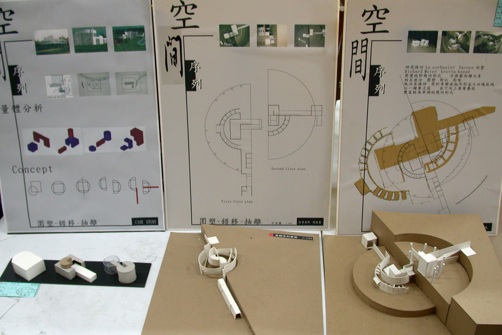
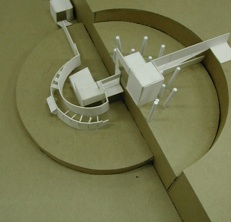
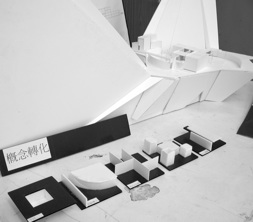
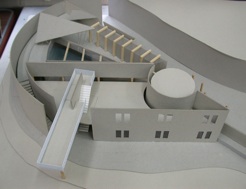
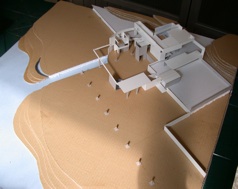
Fig. 34-38. Examples of final designs. The design process, analytical diagram, drawings and models had to be organized as a set of presentations.
Reflection on the outcome
After six weeks of implementing the revised assignment, the tutors reviewed students’ projects not only based on the final model of the spatial composition, but also referring to their presentation of the process of case analysis. The purpose was not to check the rigorous connection between the cases and their design outcomes, but to stress the importance of revealing design processes rather than just showing results. As mentioned previously, case reference and analysis was arranged to be a means to approach this design but not the norm to be obeyed, so the evaluation focused more on whether students progressed through the process and obtained the capacity to articulate serial spaces. Yet in terms of didactics, the discussion here is concerned with how the new adjustments of the assignment affected students’ learning outcome.
Repeating the analyzing-then-creating process did indeed assist students in adopting the way of forming spaces that the cardboard exercise intends to. The fast pace at the early stage that jumped between analytical case study and form/space creation provided abundant occasions for students to build up experiences for the later elaboration on the project. Although there was no evidence that students’ improvement was due to this repetition, the degree of separation between analysis and synthesis decreased. We found that more concepts and ideas derived from the case analyses were applied, in one way or another, in the students’ final projects.
Introducing new cases for reference apparently extended students’ visions on the principles derived from the first case study. The projects students came up with after this modification showed more compositional variations in formal concept than before. The notion of topological continuation came into play [image21.jpg, image36.jpg image37.jpg]. Some students even managed to interpret the projects alternatively and proposed extraordinary solutions [image41.jpg, image42.jpg]. The results suggest that, if we provide learners with more relevant incentives, they may display more creativity. Nevertheless, this adjustment did not aim to provoke innovation, but to elevate novices’ capacity with potential approaches exemplified in the cases presented.
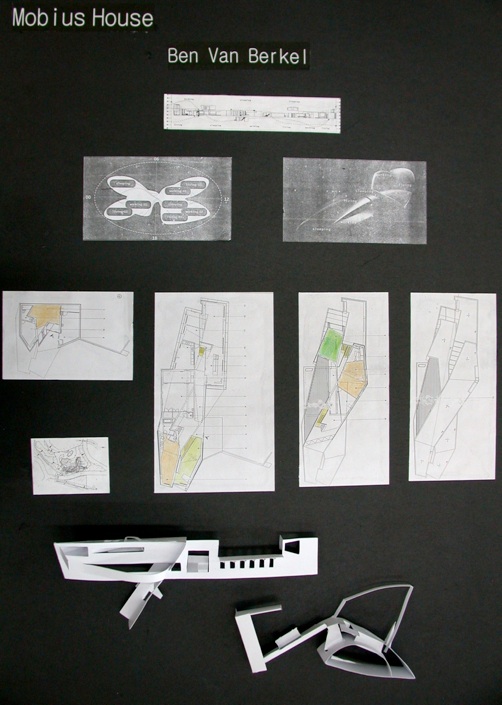
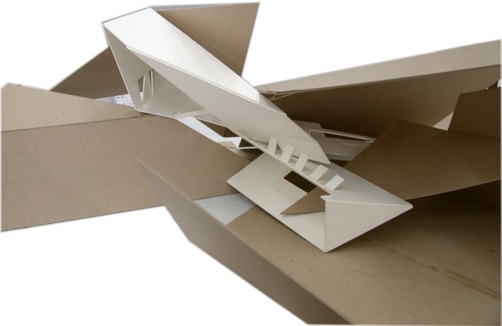
Fig. 39-40. New cases brought advanced ideas of formal operation. The concept of a Möbius strip was adopted through case analyses and applied to students’ final project.
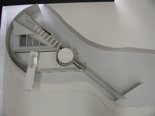
Fig. 41-43. Columns did not really influence the spatial characters in some final projects.
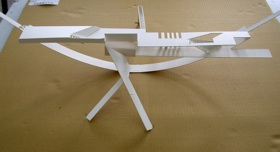
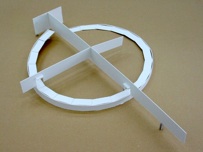
Fig. 44-45. Two different interpretations showed alternative solutions to the assignment. These two projects followed the same rules of operation, but transformed the cardboard into extraordinary compositions.
Ideally, adding linear elements (vertical sticks as columns) should reinforce, redefine, or complement the spatial sequence created by planar elements. Since the columns were put together afterwards, it allowed students to examine the whole complex they had created and adjust it accordingly. Although this extra move was intended to prepare students for the next assignment, the column-like elements acted differently in this project. Here they were not pre-existent and dominant, and therefore played an ancillary role in the spatial composition. Thus this new set of elements did not seem to interact strongly with the established components. Yet at least the experience of playing with these two types of formal element may have been constructive for students to cope with the next assignment.
Studio assignment as subject of evolution
This essay reports the experience gained in modifying a design assignment, without suggesting that this method is the best way to teach form making in architectural design education. It does not serve to justify the approach taken in the assignment or the value of formal style exemplified by the cases used, but aims to highlight that tutors should be aware of the importance of assignments’ evolution in shaping design teaching in architecture.
To sum up the experience of devising the assignment, we discuss three points for reflection.
Bringing cases into studio
The purpose of this basic design studio assignment was making form to shape space, which is essential to architectural design. It started from a game of playing with one piece of cardboard to construct spatial sequences, and developed into a proliferated exercise for building up several design capacities. A hands-on mode of learning interacting with case-based reasoning evolved to be the backbone of this case.
Albeit case reference and analysis is a widespread approach in design activity, it is rarely incorporated explicitly in contemporary design studio teaching. The teachers recognized that novice designers have difficulty to sense, analyze, and make use of knowledge acquired from cases without proper guidance. Yet guidance tends to rely heavily on tutors’ personal preferences and their ability to interact with students, in other words, it is operated implicitly. Therefore the assignment was designed to reify the thinking process as a collective learning action in studio format. As shown above, the original version made a first attempt, and the revised version amended it to further reinforce it.
Assignments as cases for reference
Many architectural schools tend to formulate series of assignments for years as suitable projects for studio teaching. From an educational viewpoint this strategy inevitably brings about both a certain level of efficiency and disadvantage. In the ideal situation it establishes a consistent trajectory for the design teaching program within the educational institution, and forms a kind of studio culture spreading over generations of students at different levels, i.e. the progress of studio learning is well maintained by following the sequence of established assignments. On the down side, however, too rigid a training program will not reflect the constantly changing reality and ideology in the domain of architecture. Identical assignments incur uncreative projects and dull instructions. Without any modification of the assignments, tutors may not stimulate new concepts to upgrade the teaching program and fail to fulfil students’ expectations.
In the school discussed here, the basic studio coordinator set up the teaching objectives for academic semesters with other tutors, and exchanged opinions on the assignments to be implemented. Usually the principles about what kinds of skills or design knowledge students should acquire had been pointed out, yet the topic and details of the operational process for each assignment were left to the discretion of the tutor(s)-in-charge. Quite often it took several group discussions before, during, and after executing the assignment to adjust or assess it according to the students’ performances. This mechanism insured a dynamic pedagogy that functioned flexibly yet fitted into an overall didactic framework.
When an assignment is retrieved from the repository and requires certain adjustments, it resembles the cognitive pattern of case reference and analysis in design thinking, only the subject alters. Tutors acknowledge that the situation is similar to, but not exactly the same as the previous one. So analysis focuses on the most indispensable elements of the assignment and its misfits in relation to the new circumstance, like in studying architectural precedents when designing a new project. Tutors’ capacity for this type of case-based reasoning may have been built up through their design training at school and accumulated experience in teaching. But to make good use of it requires awareness and skills at the meta-level (Chen et al. 2007). It is crucial that tutors are aware of what they are going to teach, in what way, and what limitations this approach might show.
Evolution to shape design teaching
Opinions often hold that re-using previous assignments may constrain innovation in design teaching, yet adequately developed assignments provide patterns for accumulating a certain ideology in architectural design. Some influential concepts embedded in studio assignments prolong the ideology they represent and become recognized principles for generations. The assignment presented in this chapter amplifies the concept of analyzing selected precedents as a pattern for accumulating design knowledge, and reflects the ideology of designerly ways of knowing as the principle for learning design. It is different from a thoroughly deliberated pedagogy, but more like a long-term evolution that reveal its true nature only gradually.
New tools such as form generation software have considerably impacted architectural design education. While these impacts may be revolutionary, eventually they will probably fall into the inescapable track of studio assignment evolution. Hands-on experience may be affected by virtual reality, but is unlikely to be replaced by it. Likewise, design teaching has certainly been shaped by studio assignments, and is constantly shaping them as it evolves.
Acknowledgement
We would like to thank Mr. Lin Chang-Ming, senior lecturer of the Department of Architecture, Feng Chia University, who taught as well the basic design studio in 2002 and provide photographs of student works for part of the illustrations.
References
Akin, O. (2002). Case-based instruction strategies in architecture. Design Studies, 23, 407-431.
Chen, J.D., Heylighen, A. & Neuckermans, H. (2007). Minding the mind in design tutoring and guiding. In Proceedings of ConnectED07: International Conference on Design Education. July 2007, Sydney, Australia: University of New South Wales. 4p. CD-Rom
Ching, F. D. K. (1996). Architecture—Form, Space, and Order. 2nd edition. New York, NY: John Wiley & Sons, Inc.
Clark, R. H. & Pause, M. (1996). Precedents in architecture. 2nd edition. London : Van Nostrand Reinhold
Dave, B., Schmitt, G., Faltings, B., & Smith, I. (1994). Case-based design in architecture. In J.S.Gero & F. Sudweeks (Eds.), Artificial Intelligence in Design ’94 (pp.145-162). Dordrecht, The Netherlands: Kluwer Academic.
Dorst, K. (1997). Describing design: a comparison of paradigms, Ph.D. dissertation, Faculty of Industrial Design Engineering, The Netherlands: Delft University of Technology
Durand, JNL (1801) Recueil et parallèle des edifices en tout genre, anciens et modernes, remarquables par leur beauté, par leur grandeur ou par leur singularité, Paris, France: Impr. De Gillé, fils.
Heylighen, A. & Neuckermans, H. (2002). Are architects natural Case-Based Designers? Experts speaking. in: The Design Journal, Volume 5, Issue 2, 2002, pp. 8-22
Heylighen, A. & Verstijnen, I.M. (2000) Exposure to examples—Exploring case-based design in architectural education. in: J. Gero (ed.), Artificial intelligence in design '00. Kluwer Academic, Dordrecht (The Netherlands), 2000, pp. 413-432
Heylighen, A. (2000). In case of architectural design― Critique and praise of Case-Based Design in architecture. Ph.D. dissertation. Leuven: Katholieke Universiteit Leuven.
Huet, B. (1984). Les trios fortunes de Durand. In Szambien, W. Jean Nicolas Louis Durand (1760-1834) : De l’imitation à la norme, Paris, France : Picard
Itten, J. (1963, 1975). Design and Form. London: Thames and Hudson Ltd. First published in Great Britain in 1963. Revised edition 1975
Ockman, J. (1984). Richard Meier, architect: 1964-1984. New York, N.Y.: Rizzoli
Polanyi, M. (1964). Personal knowledge: towards a post-critical philosophy. New York, N.Y.: Harper and Row.
Schön, D. (1985). The design studio. London: RIBA Publications Limited.